Posts

BE YOURSELF WHILE MAKING PRESENTATION OR SPEECH

Be yourself Probably you have come across this advice more often than not. Certainly I’ve come across this advice about making presentations in quite a few places over the years. It seems to be quite good but somewhat limited and occasionally wrong. When this is said, it is generally meant to be good – usually spoken by a friend just before a terrified speaker goes up on stage in a last minute attempt to reassure them that all will be well – but the truth is that being a good speaker requires more than being yourself. If one need to be yourself to be a good speaker, then everyone of us would have been a good speaker. In other words - You need to “be yourself” and you need to “perform” at the same time – in other words you need to be yourself and have good presentation skills. Difficult? Of course it is or we all would be doing it. Think of the techniques to help you to perform the day to day activities like walking. Once we know how to walk,...

HAMMERING THE MESSAGE WITH DIFFERENCES

Image
Differences Count When You Are Presenting You’ve got a big presentation coming up and you know that you want to make a difference and have the audience walk away with a good understanding of the complex info that you are going to present. What can you do to really make sure that you key points get hammered home? You want to get your understanding itched into the audience. You want to surprise them with your presentation. What can you do? Setting the stage on fire can be great but impractical way to accomplish this. How about two simpler ways that us technical folks always seem to forget as we pull together our presentations? Audience Attention is drawn to perceptible differences Let’s say that you’ve got a slide that contains one of the key points that you want to make to your audience. There are probably other things on that slide (like a title?). You need to make sure that your key point, be it a number, a comparison, a figure, etc. jumps out at your audience. All o...

THE ART OF PERSUASION

Image
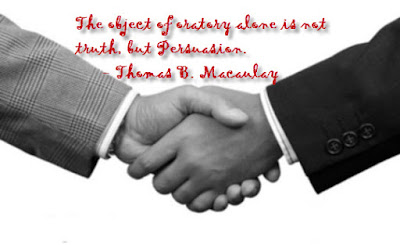
Persuade person with elegance At some point everyone tries to persuade someone else for something. It may be selling a product or lobbying for a promotion or even just trying to win a debate competition.  As we face challenges from the person/persons we are trying to persuade, we try to be push harder.  But, the harder you push the more people have a tendency to get defensive and back away. This is one of the most important challenges faced by a leader / person when one tries to get the work done from his / her subordinates / colleagues. Good persuasion is a skill. It's a give and take allowing for people to move at their own pace with some steady nudging. Some are good at it but others needed to learn it from scratch. But both have to continuously practice it. There are a number of effective and inoffensive considerations and techniques that can help with pleasant persuasion. Make it discreet Often, talking through a point gets lost. People have a strong...

PROJECT 6 – THE VOCAL VARIETY - SPEECH

Image
As discussed in my previous blog my Toastmaster Project 6 - "Vocal Variety" was named “The Wind”. The speech was about finding a relation between nature and life. The speech was written in a way to have a drama, inorder to incorporate both movement and vocal variety . In red are the emphasis I had attempted of incorporating. ~~~~~~~~~~~~~~~~~~~~~~~“THE Wind”~~~~~~~~~~~~~~~~~~~~~~ Fellow Toastmasters and guests… A few years ago while I was in India, my wife and I traded our condo keys for house keys. Our floor space doubled, but there were two much larger changes. First, our mortgage jumped from something quite manageable to something which scares me considerably. Second, the few hours that I once affectionately called “free time” (emphasize it with a sarcastic voice and imaginary quotation sign) became known as “yard work.”  Yard work is a bit like working at MDA for me. I don’t have any clue what I should be doing half the time, but somehow I always end up be...

TOASTMASTER PROJECT 6 – VOCAL VARIETY

Image
Ever heard of the saying “It’s not what you say it’s how you say it?” Does your voice put your audience to sleep? Does it put you to sleep? Do you find it hard to convey emotions with your voice? Are you easy to listen to, or does your voice let you down? Toastmasters Project 6 – Vocal Variety guides you to harness your own voice. The previous projects were about communicating coherent ideas, simply, and to the point. This project takes it a notch higher making you aware of how to use your voice to communicate. The most interesting thing is that we innately know how to use our voices to convey excitement, joy, surprise love or sadness as these are all key ingredient of our daily and we unconsciously use it almost all the time. In speech or public speaking we are conscious that our voice has to communicate the emotion we have to say, and that’s where something strange happens and we forget the very basics. Remember that our voice is the best tool available i...

HOW TO USE QUOTES IN YOUR SPEECH: BENEFITS AND TIPS

Image
Ask any professional speechwriter and he will tell you that most people in an audience will forget 90 percent of a speech by the morning after it is delivered. But amazingly, people in the same audience can repeat a well-chosen quotation or humorous item from a speech -- sometimes as long as several years later. Every speech does not need quotations, but every speaker needs to know why, how, and when to use quotations in their speeches . Benefits of Quote There are numerous benefits to crafting quotations into your speech, including: The primary reason to quote material in your speech is that it reinforces your ideas. A quotation offers a second voice echoing your claims, but is more powerful than simply repeating yourself in different words. Generally the quotes are from a well renowned person. By using the quote we can piggybank on them to enhance our credibility Quotes usually offer a concise and memorable phase, that has a proven track record Quotations a...

TIPS FOR IMPROVING LISTENING SKILLS

Tips for Listening – Leadership Skill The basic of leading is to have a very constructive communication with the persons you want to lead. It is simply not possible to be a great leader without being a great communicator. This partially accounts for why we don’t encounter great leadership more often. The big miss for most leaders is that they fail to understand that the purpose of communication is not to message, but to engage – THIS REQUIRES LISTENING. Don’t be fooled into thinking that being heard is more important than hearing. The first rule in communication is to seek understanding before seeking to be understood. Communication is not a one way street. Great leaders, never miss an opportunity to listen. In fact, they aggressively seek out new and better ways to listen. In the previous blog we discussed the other benefits of listening skills. Here we will be looking into the skills for becoming a better listener. Tips of becoming better listener Listen with an o...